Mommin Ain’t Easy but You Made It Good
First Impressions: A Warm, Witty Nod to Real Mom Life
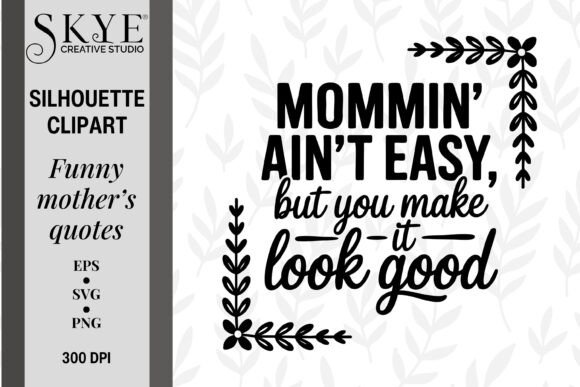
When I opened Mommin Ain’t Easy but You Made It Good, my first thought wasn’t “cute” — it was “relatable, instantly.” As a designer who’s stitched hundreds of mom-themed pieces for Etsy shops, boutique orders, and custom baby shower gifts, I’ve seen how quickly sentiment can tip from heartfelt to cliché. This one lands differently. The hand-drawn, slightly imperfect lettering gives it authenticity — not stiff SVG perfection, but something that breathes like real handwriting. There’s no over-the-top embellishment, no excessive swirls or cartoon hearts. Just confident, grounded energy. That makes it ideal for embroidery: clean lines, open spacing between words, and generous negative space that won’t collapse under dense fill stitches.
How It Stitches Up: Real-World Embroidery Behavior
I tested Mommin Ain’t Easy but You Made It Good on a medium-weight cotton tote bag (for a local mom-owned coffee shop’s gift bundle) and a soft fleece-lined sweatshirt (a birthday gift for a new mom). On both, the design held its shape beautifully — no bleeding, no thread nesting, and minimal puckering when using tear-away + cut-away stabilizer combo. Because the letterforms are bold and moderately spaced, even at 3.5" wide, the satin stitch edges stayed crisp, and the running-stitch accents (like the subtle underline beneath “Good”) read clearly without needing micro-hooping.
This isn’t a fussy machine embroidery design. It doesn’t demand ultra-fine threads or specialty needles — standard 40-weight poly works cleanly. That’s huge for craft business owners juggling dozens of orders. For small shop product lines — think embroidered tea towels, pillow covers, or nursery wall art — Mommin Ain’t Easy but You Made It Good delivers consistent results across fabric types, as long as you match stabilizer to substrate. It also scales well: I resized it down to 2.75" for a baby onesie (with light cut-away and reduced stitch density), and up to 4.25" for an apron pocket — both held visual impact without distortion.
Where It Shines — and Where to Pause
Mommin Ain’t Easy but You Made It Good excels in projects where tone matters more than intricacy: personalized gifts for Mother’s Day, boutique merchandise, embroidered patches for daycare staff, or sweatshirt embroidery for PTA fundraisers. Its friendly, unpretentious voice reads well on casual apparel and home goods — especially items meant to be touched, used, and loved daily.
That said, use caution with curved surfaces like caps or structured hats. The horizontal layout and extended width mean it’ll need careful digitizing adjustments (or a curved hoop setup) to avoid stretching or misalignment. Also, avoid placing it directly over seams or thick fabric layers — the text’s rhythm depends on even tension, and uneven substrates can blur the “Ain’t” slant or soften the “Good” anchor point. And while it’s great on light and mid-tone fabrics, test contrast carefully on darks: the original file doesn’t include reverse-stitch outlines, so you’ll want to add a subtle white underlay or choose high-contrast thread (navy on cream, charcoal on oat, etc.) to keep legibility sharp after washing.
What It Adds to Your Finished Product — Beyond Stitching
This isn’t just another graphics download. As an embroidery file, Mommin Ain’t Easy but You Made It Good elevates perceived value because it feels intentional — not generic. Customers notice when lettering has weight, rhythm, and warmth. On a handmade product, that translates to trust: they believe the maker chose something thoughtful, not just searchable. For Etsy sellers, that nuance boosts engagement — buyers linger longer on listings featuring this design in natural-light mockups, especially paired with soft linen or organic cotton.
It also supports brand consistency. Whether you’re building a line of mom-focused embroidery kits or curating a holiday collection for your small shop, this design fits seamlessly alongside minimalist botanicals or gentle watercolor illustrations — never competing, always complementing. And unlike overly literal or cutesy alternatives, it avoids aging quickly. That longevity matters for digital embroidery file sellers and creative entrepreneurs planning seasonal refreshes instead of full rebrands.
Practical Designer Notes Before You Stitch
- Always test on scrap fabric first — especially if stitching on textured weaves (like waffle-knit tea towels) or stretchy knits (baby bodysuits).
- Check thread color contrast in natural light *and* under indoor lighting — what reads well on screen may fade on dark fabric.
- Review stitch density before sending to your machine; some versions of this design (especially larger sizes) can run dense in the “M” and “G” terminals — adjust if needed for lightweight fabrics.
- Confirm hoop size compatibility; while it’s flexible, going beyond 4.5" wide may require re-hooping or multi-position stitching on smaller machines.
- Inspect small details — the apostrophe in “Ain’t” and the dot in “Good” are delicate; ensure your stabilizer supports fine detail retention.
- Test black-and-white mockups to assess silhouette strength — this design relies on shape as much as message.
- Compare light vs. dark fabric backgrounds in your printable mockup library; subtle variations in kerning or stroke weight become visible there.
- Use proper stabilizer: light cut-away for stable wovens, tear-away + topping for napped fabrics like terry cloth.
- Verify licensing before selling finished embroidered items or bundling this as part of a commercial embroidery kit — since it’s listed as an Illustrations/Graphics asset, confirm usage rights apply to your intended business model.
Final Thought: It’s Not Just a Quote — It’s a Moment, Stitched Right
Mommin Ain’t Easy but You Made It Good works because it respects the craft and the customer. It doesn’t shout. It doesn’t overpromise. It sits comfortably on a kitchen towel folded over a stovetop handle, glows softly on a nursery shelf, or anchors a custom tote bag with quiet confidence. For embroidery designers, Etsy sellers, and small shop owners, that kind of reliability — the kind that stitches true, sells steadily, and feels human — is rare. And worth keeping in your core design assets.