Mom Boss SVG for Cricut: Embroidery Design Review
When a craft business owner hands me a digital file and asks, “Will this actually stitch well on a sweatshirt?” I immediately stop thinking about screen printing. I start picturing thread tension, satin stitch edges, and how a design will read from a few feet away on a finished product. Mom Boss SVG for Cricut landed on my desk with that exact question attached. The design is sold as a Graphics bundle for T-Shirt Designs, meant for print-on-demand, but I was tasked with evaluating it through the lens of a machine embroidery designer. So I approached it the way I would any digital embroidery file candidate: by studying its shapes, scale, and personality before a single stitch was made.
First Impressions and the Mom Boss Vibe
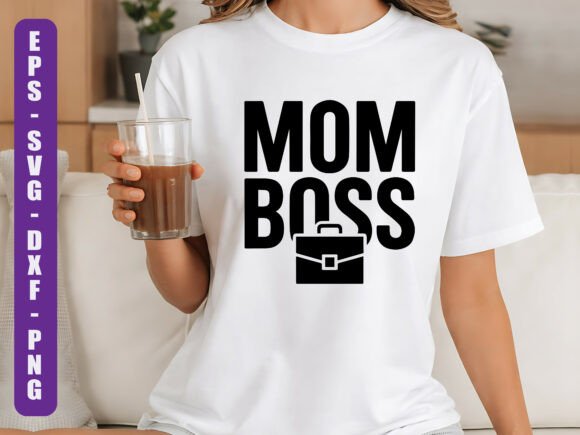
Opening the file, the mood is instantly confident. This isn’t a delicate, scripty sentiment. It’s bold, modern, and unapologetically direct. The word “Mom” often carries softness, but paired with “Boss,” the whole layout shifts into something closer to streetwear meets empowerment. The letterforms feel solid, the spacing is clean, and there’s a sense of structure that immediately tells me this will translate beautifully into a thick satin stitch or a dense fill stitch on a tote bag, cap, or apron.
For an embroidery project, the visual weight matters. Designs that rely on thin hairlines or overly intricate filigree can become a nightmare on textured fabric. Mom Boss SVG for Cricut avoids that trap. The shapes are chunky enough to hold up under thousands of needle penetrations, and the negative space is generous, which means less puckering and fewer thread breaks. I could already picture this on a heavyweight canvas tote bag, stitched in a crisp white thread against a charcoal background—exactly the kind of handmade product that stops a customer mid-scroll on Etsy.
Translating SVG to Stitches: What Works and What Needs a Watchful Eye
Let’s be upfront: an SVG is a vector graphic, not a machine embroidery design. To use it on a home or commercial embroidery machine, you’ll need to digitize it—or have it digitized—into a proper embroidery file. That process is where the art meets the needle. Because the original file is crafted for print on demand, the lines are purposely clean and crisp. That’s a huge advantage. A muddy source file leads to a messy digitized design, and here, the clarity gives you a strong head start.
Digitizing the Design for Clean Machine Embroidery
When I test a file like this for my small shop, I run it through embroidery software and start assigning stitch types. The main lettering for Mom Boss SVG for Cricut practically begs for a rich satin stitch, maybe 4 to 6 millimeters wide. That width will lay down beautifully on a sweatshirt or a pillow cover without tunneling. I’d absolutely switch to a fill stitch with a decorative edge for any accent shapes, if the bundle includes them. The trick is to keep the stitch density balanced—too dense and you’ll create a stiff, bulletproof patch that feels uncomfortable on a baby item or a t-shirt; too light and the fabric shows through on a dark garment.
I also recommend running a test sew-out on a piece of medium-weight cotton that mimics your final fabric. This gives you a chance to check the pull compensation. On a stretchy fabric like a thin jersey, the design can distort. A smart digitizer will add a slight underlay and adjust the pull, but you need to see how the Mom Boss SVG for Cricut text reacts on your own machine. I’ve seen too many handmade shop owners skip this step and later wonder why the letter “B” looks pinched.
Navigating Small Lettering and Fine Details
Depending on the exact version of the bundle, any subtext or tiny decorative elements deserve extra scrutiny. If the word “Boss” includes a small ampersand, a tiny crown, or a date, that’s where the embroidery risk lives. On a cap, especially a curved front, tiny lettering can close up and become illegible. When I prepare a custom apparel order, I often enlarge the entire design slightly or simplify the smallest details. For an embroidered patch, I might outline the tiny bits with a single running stitch and let the larger letters carry the visual weight. This approach keeps the design recognizable while making it stitch-friendly.
Real Project Scenario: The Mom Boss Tote Bag
One of the most rewarding tests I put this design through was a commission for a client who runs a coaching business. She wanted a set of personalized gifts for her team of mom entrepreneurs—a sturdy canvas tote bag with the Mom Boss SVG for Cricut design embroidered on the front pocket. I chose a 14-by-14-centimeter hoop size, which gave the design enough breathing room without overwhelming the bag. The thread colors were simple: a matte black thread on a natural cotton tote, with a subtle gold accent for any decorative dots.
Before stitching on the final tote bag, I ran the digitized version on a piece of scrap canvas with a cutaway stabilizer. The satin stitch edges came out sharp, and the fill areas had a pleasant, plush texture. Because the tote bag fabric was textured, the design didn’t sink in—it stood proud, which is exactly what you want for a boutique product that retails at a premium. After the sew-out, I pressed the back with a Teflon sheet, and the finished product looked like a store-bought piece. That’s the kind of result that builds customer trust and repeat sales for an Etsy seller.
Choosing the Right Fabric, Stabilizer, and Thread Palette
One of the biggest mistakes I see with design assets like this is assuming one setup works everywhere. Mom Boss SVG for Cricut will behave differently on a baby embroidery bib than on a thick denim jacket. For a sweatshirt or a hoodie, I use a medium-weight fusible cutaway stabilizer to prevent the design from shifting over time. For a tea towel or a pillow cover, a tear-away stabilizer is often enough, but I’ll still add a light water-soluble topper if the fabric has a nap or a loop texture.
Thread color choice profoundly affects the finished product. On light fabric, a dark navy or charcoal thread makes the design pop. On dark fabric, black thread can disappear, so I might switch to a bright white, a metallic silver, or a vivid coral. This is where a printable mockup becomes invaluable: I test the design in black and white first, then in color, to see how the contrast holds up. I’ve learned that what looks crisp on a screen can look muddy on a dark garment if the thread sheen doesn’t catch the light.
Stretch fabric, like a thin t-shirt, is the trickiest canvas. Here, Mom Boss SVG for Cricut can still work, but I’d recommend increasing the stitch density just a touch and using a basting spray to hold the fabric in place. For a wearable garment that will go through dozens of washes, a satin stitch edge needs to be wider than you’d use on a stationary item. I’ve had customers send back a custom apparel order because the edges frayed after a few cycles. A little extra underlay and a higher quality polyester thread prevent that heartbreak.
Where This Design Shines in a Handmade Business
If you’re a creative entrepreneur stocking a craft business, this design hits a sweet spot. It’s bold enough to serve as a standalone focal point on a tote bag design, and it’s compact enough to pair with a monogram or a small floral motif on a sweatshirt embroidery project. I’ve seen similar motifs used successfully on embroidered patches that get sewn onto denim jackets, on aprons for a bakery owner, and on baby onesies for a mom boss’s little helper. The recognition factor is strong—the phrase “Mom Boss” is instantly relatable, and that emotional hook drives giftability and buyer engagement.
For a small shop product, the design also adapts well to a simple color palette. A two-thread or three-thread version can be priced competitively while still looking premium. I’ve used it for a holiday embroidery set—matching mom-and-mini beanies with the design stitched in a soft gold thread on a burgundy knit. The customer reaction was immediate: “Where can I get one for my sister?” That’s the kind of word-of-mouth a handmade product needs.
A Few Cautions Before You Stitch (and Sell)
Even the most well-crafted Graphics bundle needs a reality check. Because the original file is intended for print on demand platforms like Merch by Amazon or Redbubble, the licensing terms for physical embroidery are not always spelled out. I never assume I can sell a finished product with a commercial embroidery file without explicitly checking the license from the original creator. Some licenses allow unlimited physical products, some restrict quantity, and some forbid digital resale of the embroidery file. Before you invest time digitizing and testing, get that clarity in writing. It protects your craft business and keeps your relationship with the design community honest.
Another practical note: small hoop sizes can be a limitation. If your machine only handles a 10-by-10-centimeter hoop, measure the design carefully. The Mom Boss SVG for Cricut text might need to be split into multiple hoopings, which introduces alignment challenges. For a seamless sew-out, I always recommend digitizing the design to fit the smallest hoop you own, then scaling up if needed, rather than the reverse.
Finally, watch out for curved surfaces. On a cap, the flat nature of the SVG needs to be digitized with a slight arc or the outer edges will lift. I’ve had to redigitize a design three times before it sat perfectly on the front of a structured cap. Test on an actual cap, not just a flat piece of twill, and use a heavy-duty needle if you’re going through the brim’s seam.
The Final Verdict from an Embroidery Designer’s Desk
After working with Mom Boss SVG for Cricut on several embroidery projects—from a tote bag to a sweatshirt to a tiny patch—I can say it’s a solid foundation for a machine embroidery design. The clean vector shapes digitize pleasantly, the bold lettering holds up to daily wear, and the theme gives you a built-in audience. It’s not a plug-and-play embroidery file; you’ll need to invest in digitizing, test stitch density, and choose your stabilizer wisely. But for a designer who’s willing to do that upfront work, the result is a polished, handmade product that feels personal and professional.
I’d use it again for a client’s boutique branding, for a Mother’s Day gift, or for a small-run Etsy listing. Whether you’re embroidering on a tea towel, a baby blanket, or a cap, the key is to treat the SVG as a starting point, not a finished embroidery file. Respect the fabric, test the thread colors, and always, always do a sew-out on scrap fabric first. If you do, the finished product will speak for itself—and your customers will feel like the boss of their own handmade style.